The first program I ever wrote made my name scroll down the left side of a Commodore screen. I was a kid in the mid-80s. I figured out how to make it repeat, and then, because one column of my name got boring fast, how to make it sprawl diagonally and fill the whole screen. That was the entire point. Not the name. The what else can I make it do.
The first program every coder is taught to write just says hello, world. Mine said my name, and then said it again, sideways, until it filled the screen. My own version of hello world.
The next time I wrote a print statement, it was in Python. That was about two months ago. Forty years between two print statements.
I'm not a developer. I was a turbine mechanic. Abrams tanks in the Marine Corps, then the same type of engines at a manufacturing company. I taught people to run the machines, then I wrote the training that taught them. No degree. I built a whole career on one thing: being the guy who learned the product deeper than anyone else and became the person you asked. That was the job security. Twenty-eight years of it, all in my head.
I actually did try real coding once, as a kid. I had a book of code, pages of it, and I typed a program out line by line just to see what would happen at the end. Turns out, a short program that prints my name all over the screen is a lot more interesting than a long one that only prints "syntax error." Not seeing the point, I quickly lost interest. That's the whole story of the forty-year gap, honestly. If something isn't interesting or immediately useful to me, I put it down, and for four decades nothing made the code matter enough.
Then a data scientist showed up at my desk.
My manager walked him over and explained that he needed all of my training materials, a career's worth, so the company could feed them into an AI and build a chatbot. And I understood, standing there, that the thing it had taken me twenty-eight years to accumulate was going to be ingested in an afternoon. The knowledge in my head wasn't the protection I'd thought it was.
So I had a choice that didn't feel like much of a choice: get on the train, or get run over by it. I helped him because that's what I do. Then I sent him a message that said anything extra you need, I'm your guy. I even had the machine punch the message up so it sounded like I knew what I was talking about. I didn't. Then I went back to the machine and asked the only question that mattered: how do I not get eaten by you? I had a long conversation with what was probably ChatGPT wearing a Copilot badge about how to become the person in my office who was good at this, instead of the first one replaced by it. I made a plan.
Here's the part I want to be honest about, because it's the part that gets mythologized: I did not then decide to build a system. I didn't decide to build anything. I just started solving problems, one at a time, and never stopped.
I built a thing at work I called JoshOS, big elaborate prompts that turned my job into a pipeline. Then I tried to copy it at home. I signed up for Angela Yu's 100 Days of Code: The Complete Python Pro Bootcamp and went at it like I was starving. Not because I love code. It was never about the code; it was about what the code could do. The syntax was a means to an end, and the end was the stuff you could make. Everything that course taught me sparked the same reflex: where can I use this? The same filter as the kid with the book of code, finally with something worth biting on. The day I learned what an API call was, I thought about a Google Ads account I had to pull reports from, an interface I hated, and realized I could just pull the numbers myself. That's how the whole thing grew. One capability, one immediate application, one solved annoyance.
Grok tutored me until I outgrew it and moved to Claude. I'd bounce Claude's code into GPT for a second opinion. This was the copy-paste era, and copy-paste is a waste of steps, so the moment a tool let me stop, I took it. That's all Claude Code was at first: not having to copy and paste. Then each agent I built solved one specific friction. Dr. Spock and Dr. Priya Nair were among the first, each one just making my life a little easier. Every brick of what I now call HexLocal was a little problem solved. One here, one there. I didn't invent anything. I applied what other people had already figured out and bent it until it worked the way I wanted.
What I kept running into were walls. Context windows: every new session was an island that forgot the last one. Then hardware: a Mac Mini with 8 gigs of RAM, then a MacBook Air with 24, and I wanted the Studio before I'd had the Air two weeks. I didn't want silicon limits any more than I'd wanted context limits. At work it was corporate governance and whatever Copilot would and wouldn't let me do. Two months of butting up against one wall after another.
And then Claude Code took the walls away, to the point where the only ones left were the ones I built myself. It's so unrestricted that I've had to put up my own guardrails. Now I spend time making Claude fight my guardrails, which is a funny place to land. The whole thing started because a wall I didn't think would fall, my job security, started to teeter. I'd built that wall on purpose, over twenty-eight years, with a lot of intention. So I started building new walls the same way.
My job is still fine. My immediate concerns, while still very present, are much more diminished. The fear was the catalyst, but it isn't what keeps me up anymore. What keeps me up is HexLocal: lying awake working out how to hand another piece of friction to an agent. It's been about two months. It feels like a hundred years.
I don't know where it goes. If I had the money I'd build a fifty-thousand-dollar machine to run a flagship model in my own house. Not because I need it, but because it would be cool, and sometimes that's the only reason. The system keeps accreting anyway. A podcast. This. A job I just applied for and immediately started running through the same machine. My dad's book. I never sat down and decided to build any of it.
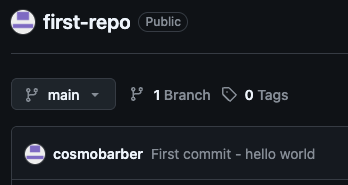
Early in the Python course, I made my first commit to GitHub. The message field is supposed to say what you changed. Mine said hello world. Not my name this time. The actual words, the ones the textbook opens with. The program every coder writes first, I wrote forty years after my first print statement.
I just keep doing the thing I did on that Commodore. That's cool. Now let's see what else I can make it do.